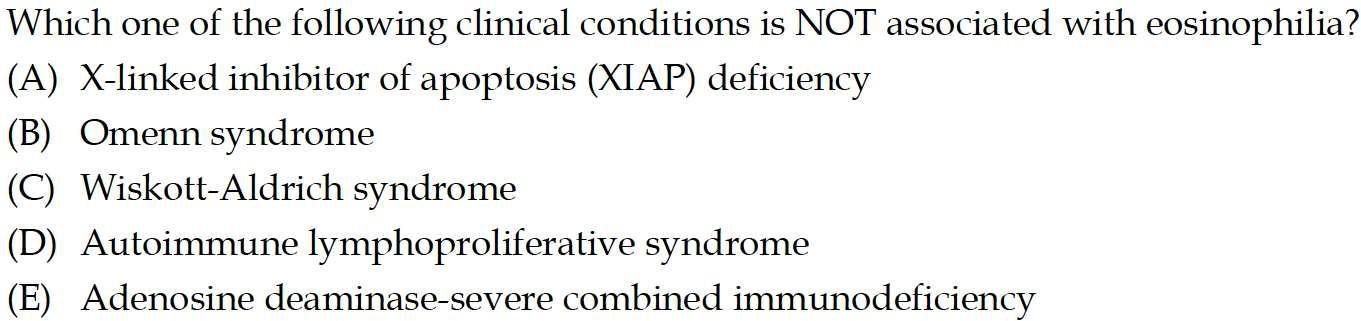
Q1. Which one of the following clinical conditions is NOT associated with eosinophilia?
- (A) X-linked inhibitor of apoptosis (XIAP) deficiency
- (B) Omenn syndrome
- (C) Wiskott-Aldrich syndrome
- (D) Autoimmune lymphoproliferative syndrome
- (E) Adenosine deaminase-severe combined immunodeficiency
點此顯示正解
(A) X-linked inhibitor of apoptosis (XIAP) deficiency
詳解
The correct answer is (A) XIAP deficiency, which is NOT typically associated with eosinophilia. XIAP deficiency (X-linked lymphoproliferative disease type 2, XLP2) presents with hemophagocytic lymphohistiocytosis (HLH), recurrent splenomegaly, inflammatory bowel disease (particularly Crohn-like colitis), and hypogammaglobulinemia, but eosinophilia is not a characteristic feature of this disorder678.
Why XIAP deficiency lacks eosinophilia:
XIAP deficiency is characterized by dysregulated apoptosis and inflammasome activation rather than the type 2 immune dysregulation that drives eosinophilia in other primary immunodeficiencies. The clinical manifestations reflect defective NOD2 signaling and impaired regulation of inflammatory responses, leading to HLH (often EBV-triggered in 33-83% of cases), recurrent HLH episodes (in 67-83% of patients), gastrointestinal inflammation with hemorrhagic colitis, and recurrent splenomegaly67[^9]. Unlike the other conditions listed, XIAP deficiency does not produce the cytokine milieu (particularly IL-5 and IL-4) that promotes eosinophil expansion[^10].
Why the other options ARE associated with eosinophilia:
(B) Omenn syndrome is a severe combined immunodeficiency variant characterized by oligoclonal T-cell expansion with a Th2 skew, leading to marked eosinophilia (often >5.0 × 10⁹/L), erythroderma, hepatosplenomegaly, lymphadenopathy, and elevated IgE. The activated, oligoclonal T cells produce type 2 cytokines that drive eosinophil proliferation135.
(C) Wiskott-Aldrich syndrome presents with eczema, thrombocytopenia, and recurrent infections. Eosinophilia occurs as part of the immune dysregulation and atopic manifestations, with elevated IgE levels commonly observed. The defect in WAS protein leads to impaired cytoskeletal regulation and aberrant immune responses favoring type 2 inflammation13.
(D) Autoimmune lymphoproliferative syndrome (ALPS) results from defective lymphocyte apoptosis (typically FAS pathway mutations), causing lymphoproliferation, autoimmunity, and immune dysregulation. Eosinophilia is a recognized feature, occurring alongside elevated IgE in many patients as part of the broader immune dysregulation13.
(E) Adenosine deaminase-severe combined immunodeficiency (ADA-SCID) can present with eosinophilia despite profound T-cell lymphopenia. The accumulation of toxic metabolites (deoxyadenosine and deoxyATP) leads to immune dysregulation with paradoxical eosinophilia and elevated IgE in some patients, particularly those with delayed-onset or "leaky" phenotypes13.
The key distinction is that severe eosinophilia (>5.0 × 10⁹/L) has been well-documented in Omenn syndrome, Wiskott-Aldrich syndrome, ADA-SCID, ALPS, IPEX, STAT3 deficiency, DOCK8 deficiency, and other primary immunodeficiencies characterized by type 2 immune dysregulation, but not in XIAP deficiency123.
詳解 · 中文翻譯
正確答案是 (A) XIAP 缺乏症,它不通常與嗜酸粒細胞增多症相關。XIAP 缺乏症(X 連鎖淋巴增殖病第 2 型,XLP2)呈現為噬血細胞淋巴組織炎(HLH)、反覆脾腫大、炎症性腸病(特別是類 Crohn 結腸炎)和低免疫球蛋白血症,但嗜酸粒細胞增多症不是此疾病的特徵性表現678。
為何 XIAP 缺乏症缺乏嗜酸粒細胞增多症:
XIAP 缺乏症的特徵是凋亡失調和炎症體激活,而非驅動其他原發性免疫缺陷嗜酸粒細胞增多症的第 2 型免疫失調。臨床表現反映了 NOD2 信號傳導缺陷和炎症反應調控受損,導致 HLH(通常在 33-83% 的病例中由 EBV 觸發)、反覆 HLH 發作(在 67-83% 的患者中)、伴隨出血性結腸炎的胃腸道炎症和反覆脾腫大67[^9]。與列出的其他病症不同,XIAP 缺乏症不產生促進嗜酸粒細胞擴增的細胞激素環境(特別是 IL-5 和 IL-4)[^10]。
其他選項為何與嗜酸粒細胞增多症相關:
(B) Omenn 症候群是一種嚴重的聯合免疫缺乏病變體,特徵為齊核 T 細胞擴增,具有 Th2 偏向,導致明顯嗜酸粒細胞增多症(通常 >5.0 × 10⁹/L)、紅皮症、肝脾腫大、淋巴結腫大和升高的 IgE。活化的齊核 T 細胞產生驅動嗜酸粒細胞增殖的第 2 型細胞激素135。
(C) Wiskott-Aldrich 症候群呈現為濕疹、血小板減少症和反覆感染。嗜酸粒細胞增多症作為免疫失調和特應性表現的一部分發生,通常觀察到升高的 IgE 水平。WAS 蛋白的缺陷導致細胞骨架調控受損和傾向於第 2 型炎症的異常免疫反應13。
(D) 自身免疫淋巴增殖症(ALPS)源自淋巴細胞凋亡缺陷(通常 FAS 通路突變),引起淋巴增殖、自身免疫和免疫失調。嗜酸粒細胞增多症是一個公認的特徵,在許多患者中與升高的 IgE 一起發生,作為更廣泛免疫失調的一部分13。
(E) 腺苷脫氨酶嚴重聯合免疫缺乏症(ADA-SCID)儘管 T 細胞淋巴細胞計數極度降低,仍可呈現嗜酸粒細胞增多症。有毒代謝物(去氧腺苷和去氧 ATP)的積累導致免疫失調,伴隨矛盾的嗜酸粒細胞增多症和一些患者中升高的 IgE,特別是延遲發作或「漏失」表型的患者13。
關鍵區別是嚴重嗜酸粒細胞增多症(>5.0 × 10⁹/L)已在 Omenn 症候群、Wiskott-Aldrich 症候群、ADA-SCID、ALPS、IPEX、STAT3 缺乏症、DOCK8 缺乏症和其他由第 2 型免疫失調特徵化的原發性免疫缺陷中有充分記載,但在 XIAP 缺乏症中沒有123。
參考文獻 (AMA)
-
Meyer L, Hines M, Zhang K, et al. X-Linked Lymphoproliferative Disease. 2004 Feb 27 [Updated 2024 May 16]. In: Adam MP, Feldman J, Mirzaa GM, et al., editors. GeneReviews® [Internet]. Seattle (WA): University of Washington, Seattle; 1993-2024. Available from: https://www.ncbi.nlm.nih.gov/books/NBK1406/. https://www.ncbi.nlm.nih.gov/books/n/gene/x-lpd. ↩↩↩↩↩↩↩↩↩↩
-
Pachlopnik Schmid J, Canioni D, Moshous D, et al. Clinical Similarities and Differences of Patients With X-Linked Lymphoproliferative Syndrome Type 1 (XLP-1/SAP Deficiency) Versus Type 2 (XLP-2/XIAP Deficiency). Blood. 2011;117(5):1522-9. doi:10.1182/blood-2010-07-298372. PMID:21119115. ↩↩
-
Yang L, Booth C, Speckmann C, et al. Phenotype, Genotype, Treatment, and Survival Outcomes in Patients With X-Linked Inhibitor of Apoptosis Deficiency. The Journal of Allergy and Clinical Immunology. 2022;150(2):456-466. doi:10.1016/j.jaci.2021.10.037. PMID:34920033. ↩↩↩↩↩↩↩↩↩↩
-
Vergneault H, Picard C, Georgin-Lavialle S. Break Down the Barriers of Auto-Inflammation: How to Deal With a Monogenic Auto-Inflammatory Disease and Immuno-Haematological Features in 2022?. Immunology. 2023;168(1):1-17. doi:10.1111/imm.13579. PMID:36151885. ↩
-
Williams KW, Milner JD, Freeman AF. Eosinophilia Associated With Disorders of Immune Deficiency or Immune Dysregulation. Immunology and Allergy Clinics of North America. 2015;35(3):523-44. doi:10.1016/j.iac.2015.05.004. PMID:26209898. ↩↩
-
Olbrich P, Ortiz Aljaro P, Freeman AF. Eosinophilia Associated With Immune Deficiency. The Journal of Allergy and Clinical Immunology. In Practice. 2022;10(5):1140-1153. doi:10.1016/j.jaip.2022.02.016. PMID:35227935. ↩↩↩↩
-
Shomali W, Gotlib J. World Health Organization and International Consensus Classification of Eosinophilic Disorders: 2024 Update on Diagnosis, Risk Stratification, and Management. American Journal of Hematology. 2024;99(5):946-968. doi:10.1002/ajh.27287. PMID:38551368. ↩↩↩↩
-
Smith KL, Dai D, Modi BP, et al. Inborn Errors of Immunity Associated With Type 2 Inflammation in the USIDNET Registry. Frontiers in Immunology. 2022;13:831279. doi:10.3389/fimmu.2022.831279. PMID:35273610. ↩↩
Slide annotations
Severe eosinophilia (>5.0 × 10^9/L) was reported in Omenn syndrome, Wiskott Aldrich syndrome, ADA deficiency, autoimmune lymphoproliferative syndrome, immunodysregulation polyendocrinopathy enteropathy X-linked, STAT3 deficiency, DOCK8 deficiency, CD40 deficiency, MHC II deficiency, Kostmann disease, Papillon-Lefevre syndrome, and CVID.
Figures