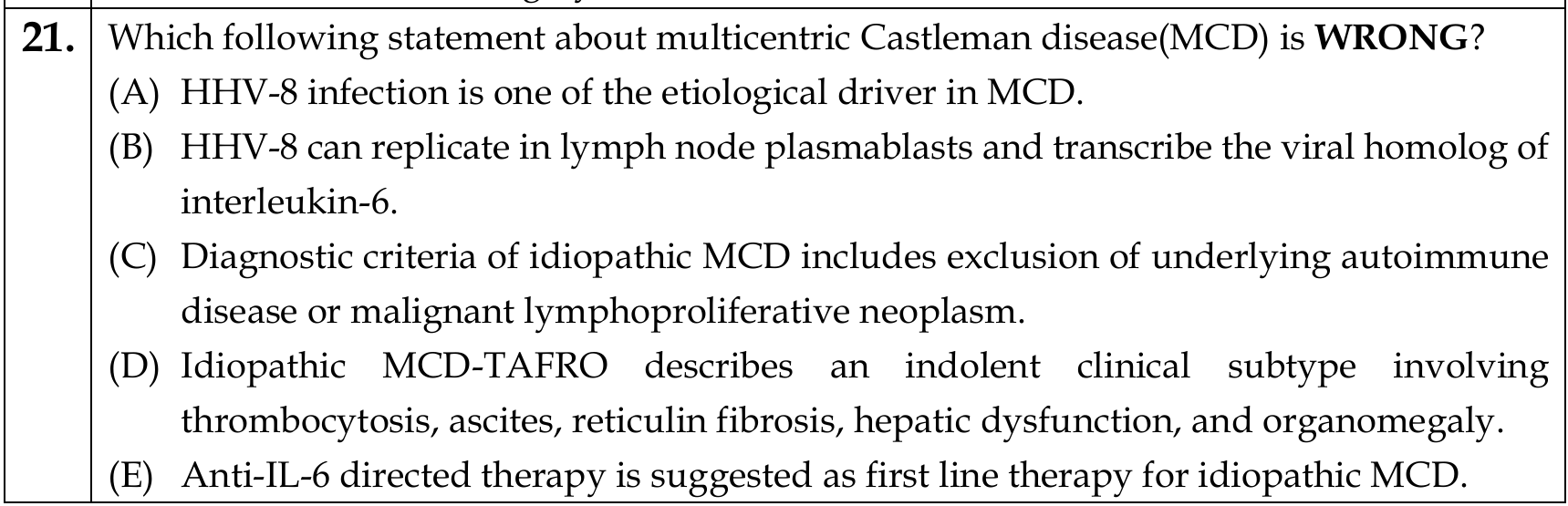
Q21. Which following statement about multicentric Castleman disease (MCD) is WRONG?
- (A) HHV-8 infection is one of the etiological driver in MCD.
- (B) HHV-8 can replicate in lymph node plasmablasts and transcribe the viral homolog of interleukin-6.
- (C) Diagnostic criteria of idiopathic MCD includes exclusion of underlying autoimmune disease or malignant lymphoproliferative neoplasm.
- (D) Idiopathic MCD-TAFRO describes an indolent clinical subtype involving thrombocytosis, ascites, reticulin fibrosis, hepatic dysfunction, and organomegaly.
- (E) Anti-IL-6 directed therapy is suggested as first line therapy for idiopathic MCD.
點此顯示正解
(D) Idiopathic MCD-TAFRO describes an indolent clinical subtype involving thrombocytosis, ascites, reticulin fibrosis, hepatic dysfunction, and organomegaly.
詳解
Why Option (D) is WRONG
Option (D) is incorrect on two counts: it describes iMCD-TAFRO as "indolent" when it is actually aggressive, and it states "thrombocytosis" when the correct feature is thrombocytopenia.
iMCD-TAFRO is an aggressive, not indolent, clinical subtype. The literature consistently describes iMCD-TAFRO as having "rapid onset cytokine storm with severe inflammation, anasarca, thrombocytopenia, and small volume lymphadenopathy, similar to hemophagocytic lymphohistiocytosis or sepsis"16. It is characterized as "the most severe cytokine storm among all iMCD patients"[^8] and "often has more severe clinical symptomatology and worse outcome" compared to other iMCD subtypes[^8].
The TAFRO acronym stands for Thrombocytopenia (not thrombocytosis). The correct acronym is: Thrombocytopenia, Anasarca, Fever, Reticulin fibrosis/renal dysfunction, Organomegaly1[7][8]. The option also incorrectly states "hepatic dysfunction" when the "R" actually refers to renal dysfunction (though reticulin fibrosis is also included).
Why the Other Options are CORRECT
(A) is correct: HHV-8 (human herpesvirus-8, also known as Kaposi sarcoma herpesvirus/KSHV) is indeed an etiologic driver of MCD. HHV-8 infection causes approximately 50% of MCD cases (HHV-8-associated MCD)23[^7]. The remaining cases are HHV-8-negative/idiopathic MCD (iMCD)4.
(B) is correct: HHV-8 replicates in lymph node plasmablasts and produces viral IL-6 (vIL-6), the viral homolog of human IL-6, which drives the hypercytokinemia characteristic of HHV-8-associated MCD25.
(C) is correct: The international, evidence-based consensus diagnostic criteria for iMCD published by Fajgenbaum et al. (Blood 2017) explicitly require exclusion of infectious, malignant, and autoimmune disorders that can mimic iMCD4. This includes exclusion of autoimmune diseases (such as rheumatoid arthritis, systemic lupus erythematosus, adult-onset Still's disease) and malignant lymphoproliferative neoplasms (such as lymphoma and POEMS syndrome)14.
(E) is correct: Anti-IL-6 directed therapy (specifically siltuximab, an IL-6 antagonist) is recommended as first-line therapy for all subtypes of iMCD according to the Castleman Disease Collaborative Network (CDCN) consensus treatment guidelines16[^7]. Siltuximab became the first FDA-approved treatment for iMCD in 2014 and consensus guidelines recommend it as front-line therapy3[^7].
詳解 · 中文翻譯
為什麼選項 (D) 是錯誤的
選項 (D) 在兩個方面不正確:當它實際上是攻擊性的時,它描述 iMCD-TAFRO 為「惰性的」,當正確特徵是血小板減少症時,它敘述「血小板增多症」。
iMCD-TAFRO 是攻擊性而不是惰性的臨床亞型。 文獻持續將 iMCD-TAFRO 描述為具有「快速發作細胞因子風暴伴嚴重炎症、anasarca、血小板減少症和小體積淋巴結病變,類似於噬血細胞淋巴組織細胞增生症或敗血症」16。它被特徵化為「所有 iMCD 患者中最嚴重的細胞因子風暴」[^8]和「常常具有比其他 iMCD 亞型更嚴重的臨床症狀和更差預後」[^8]。
TAFRO 首字母縮略詞代表血小板減少症(而不是血小板增多症)。 正確的首字母縮略詞是:Thrombocytopenia、Anasarca、Fever、Reticulin fibrosis/renal dysfunction、Organomegaly1[7][8]。選項也不正確地敘述「肝功能障礙」當「R」實際上指腎功能障礙(儘管網狀纖維母細胞纖維化也包括)。
為什麼其他選項是正確的
(A) 正確: HHV-8(人皰疹病毒 8、也稱為 Kaposi 肉瘤皰疹病毒/KSHV)確實是 MCD 的病因驅動因素。HHV-8 感染導致約 50% 的 MCD 病例(HHV-8 相關 MCD)23[^7]。其餘病例為 HHV-8 陰性/特發性 MCD(iMCD)4。
(B) 正確: HHV-8 在淋巴節漿細胞母細胞中複製並產生病毒 IL-6(vIL-6),人 IL-6 的病毒同源物,驅動 HHV-8 相關 MCD 特徵的高細胞因子血症25。
(C) 正確: Fajgenbaum 等人(Blood 2017)發表的 iMCD 國際、基於證據的共識診斷標準明確需要排除可模擬 iMCD 的傳染性、惡性和自身免疫疾病4。這包括排除自身免疫病(例如類風濕關節炎、系統性紅斑狼瘡、成人發作 Still 病)和惡性淋巴增生性腫瘤(例如淋巴瘤和 POEMS 綜合症)14。
(E) 正確: 根據 Castleman 病協作網絡(CDCN)共識治療指南,抗 IL-6 指導療法(具體而言,siltuximab,IL-6 拮抗劑)推薦作為所有 iMCD 亞型的一線療法16[^7]。Siltuximab 在 2014 年成為第一個 FDA 批准的 iMCD 治療方法,共識指南推薦其作為前線療法3[^7]。
參考文獻 (AMA)
-
Chen LYC, Zhang L, Fajgenbaum DC. Expert Perspective: Diagnosis and Treatment of Castleman Disease. Arthritis & Rheumatology (Hoboken, N.J.). 2026;78(1):12-25. doi:10.1002/art.43269. PMID:40457814. ↩↩↩↩↩↩↩↩
-
Zhang L, Ge JY, Li SY, et al. Idiopathic Multicentric Castleman Disease-Tafro: A Potentially Curable Disease?. American Journal of Hematology. 2026;101(3):447-455. doi:10.1002/ajh.70199. PMID:41518092. ↩↩↩↩
-
Fajgenbaum DC. Novel Insights and Therapeutic Approaches in Idiopathic Multicentric Castleman Disease. Blood. 2018;132(22):2323-2330. doi:10.1182/blood-2018-05-848671. PMID:30487129. ↩↩↩↩
-
Carbone A, Borok M, Damania B, et al. Castleman Disease. Nature Reviews. Disease Primers. 2021;7(1):84. doi:10.1038/s41572-021-00317-7. PMID:34824298. ↩↩↩↩↩↩
-
Fajgenbaum DC, Uldrick TS, Bagg A, et al. International, Evidence-Based Consensus Diagnostic Criteria for HHV-8-negative/idiopathic Multicentric Castleman Disease. Blood. 2017;129(12):1646-1657. doi:10.1182/blood-2016-10-746933. PMID:28087540. ↩↩
-
Fajgenbaum DC, van Rhee F, Nabel CS. HHV-8-negative, Idiopathic Multicentric Castleman Disease: Novel Insights Into Biology, Pathogenesis, and Therapy. Blood. 2014;123(19):2924-33. doi:10.1182/blood-2013-12-545087. PMID:24622327. ↩↩↩↩
Slide correction
aggressive
Slide annotations
Thrombocytopenia
Figures