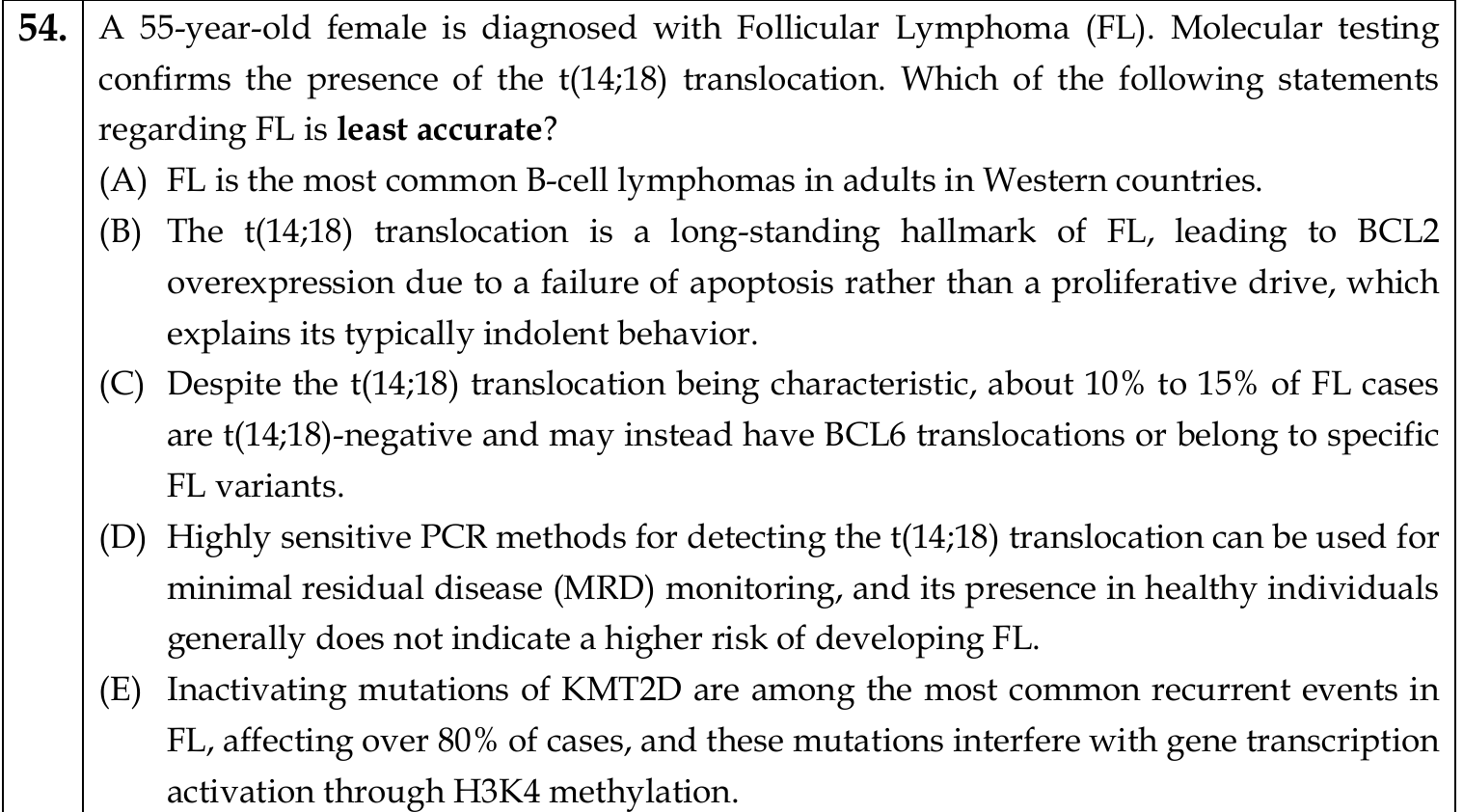
Q54. A 55-year-old female is diagnosed with Follicular Lymphoma (FL). Molecular testing confirms the presence of the t(14;18) translocation. Which of the following statements regarding FL is least accurate?
- (A) FL is the most common B-cell lymphomas in adults in Western countries.
- (B) The t(14;18) translocation is a long-standing hallmark of FL, leading to BCL2 overexpression due to a failure of apoptosis rather than a proliferative drive, which explains its typically indolent behavior.
- (C) Despite the t(14;18) translocation being characteristic, about 10% to 15% of FL cases are t(14;18)-negative and may instead have BCL6 translocations or belong to specific FL variants.
- (D) Highly sensitive PCR methods for detecting the t(14;18) translocation can be used for minimal residual disease (MRD) monitoring, and its presence in healthy individuals generally does not indicate a higher risk of developing FL.
- (E) Inactivating mutations of KMT2D are among the most common recurrent events in FL, affecting over 80% of cases, and these mutations interfere with gene transcription activation through H3K4 methylation.
點此顯示正解
(A) FL is the most common B-cell lymphomas in adults in Western countries.
詳解
Analysis of Board Question
1) Why (A) is the LEAST ACCURATE (incorrect) statement:
Option (A) states that FL is the most common B-cell lymphoma in adults in Western countries. This is incorrect. Follicular lymphoma is the second most common non-Hodgkin lymphoma in Western countries, accounting for approximately 20-35% of all non-Hodgkin lymphomas1245. Diffuse large B-cell lymphoma (DLBCL) is the most common B-cell lymphoma overall. While FL is indeed the most common indolent lymphoma in Western populations16, it is not the most common B-cell lymphoma when all subtypes are considered together.
2) Why the other options are TRUE:
(B) is TRUE: The t(14;18) translocation is indeed a hallmark of FL, resulting in BCL2 overexpression through juxtaposition of the BCL2 gene to the IGH locus[8][9]. This translocation leads to constitutive BCL2 protein expression, which allows B cells to abrogate the germinal center apoptotic program[^8]. The mechanism is fundamentally anti-apoptotic rather than proliferative, which explains FL's characteristically indolent clinical behavior. The t(14;18) translocation itself is insufficient to cause complete transformation and represents one of the earliest genetic events[^9].
(C) is TRUE: Approximately 85% of classic follicular lymphomas harbor the t(14;18) translocation16, meaning about 10-15% are t(14;18)-negative. These t(14;18)-negative cases include specific FL variants such as follicular large B-cell lymphoma (grade 3B), which frequently lacks t(14;18) but may have other alterations16. BCL6 translocations and other molecular features can be present in these t(14;18)-negative variants.
(D) is TRUE: The t(14;18) translocation can be detected by highly sensitive PCR methods and has been used for minimal residual disease monitoring. Importantly, t(14;18)-positive B cells can be found in healthy individuals without lymphoma4[8][10]. The presence of this translocation in healthy individuals does not necessarily indicate higher risk of developing FL, as the translocation alone is insufficient for malignant transformation and requires additional genetic events[8][9][^10].
(E) is TRUE: KMT2D (also known as MLL2) mutations are among the most common recurrent genetic alterations in follicular lymphoma. These inactivating mutations are found in the vast majority of FL cases7, with studies showing mutations in histone modifiers including KMT2D, CREBBP, EZH2, MEF2B, and EP3007. KMT2D encodes a histone methyltransferase that catalyzes H3K4 methylation, which is important for gene transcription activation[^8]. The statement that these mutations affect over 80% of cases and interfere with H3K4 methylation-mediated transcription activation is accurate.
詳解 · 中文翻譯
板考分析
1) 為什麼 (A) 是最不準確的(不正確的)敘述:
選項 (A) 陳述 FL 是西方國家成人中最常見的 B 細胞淋巴瘤。這是不正確的。濾泡淋巴瘤是西方國家第二最常見的非何杰金淋巴瘤,佔所有非何杰金淋巴瘤的約 20-35%1245。瀰漫大 B 細胞淋巴瘤(DLBCL)是整體最常見的 B 細胞淋巴瘤。雖然 FL 確實是西方人口中最常見的惰性淋巴瘤16,但在考慮所有亞型的情況下,它不是最常見的 B 細胞淋巴瘤。
2) 為什麼其他選項是正確的:
(B) 是正確的:t(14;18) 易位確實是 FL 的特徵,通過 BCL2 基因與 IGH 位點的並置導致 BCL2 過度表達[8][9]。此易位導致組成型 BCL2 蛋白表達,允許 B 細胞廢除生發中心凋亡程序[^8]。該機制從根本上是抗凋亡的而不是增殖的,這解釋了 FL 的典型惰性臨床行為。t(14;18) 易位本身不足以引起完全轉化,並代表最早的遺傳事件之一[^9]。
(C) 是正確的:約 85% 的經典濾泡淋巴瘤攜帶 t(14;18) 易位16,意味著約 10-15% 是 t(14;18) 陰性。這些 t(14;18) 陰性病例包括特定 FL 變體,如濾泡大 B 細胞淋巴瘤(3B 級),經常缺乏 t(14;18) 但可能具有其他改變16。BCL6 易位和其他分子特徵可能存在於這些 t(14;18) 陰性變體中。
(D) 是正確的:t(14;18) 易位可以通過高度敏感的 PCR 方法檢測到,並已用於最小殘留病監測。重要地是,t(14;18) 陽性 B 細胞可以在沒有淋巴瘤的健康個體中被發現4[8][10]。此易位在健康個體中的存在不一定表明 FL 發展風險較高,因為易位本身不足以進行惡性轉化,並需要額外的遺傳事件[8][9][^10]。
(E) 是正確的:KMT2D(也稱為 MLL2)突變是濾泡淋巴瘤中最常見的反覆遺傳改變之一。這些失活突變在 FL 病例的絕大多數中被發現7,研究顯示組蛋白修飾子中的突變,包括 KMT2D、CREBBP、EZH2、MEF2B 和 EP3007。KMT2D 編碼組蛋白甲基轉移酶,催化 H3K4 甲基化,對基因轉錄激活很重要[^8]。這些突變影響超過 80% 的病例並干擾 H3K4 甲基化介導的轉錄激活的敘述是準確的。
參考文獻 (AMA)
-
Silkenstedt E, Salles G, Campo E, Dreyling M. B-Cell Non-Hodgkin Lymphomas. Lancet (London, England). 2024;403(10438):1791-1807. doi:10.1016/S0140-6736(23)02705-8. PMID:38614113. ↩↩↩↩↩↩↩↩
-
Caridà G, Martino EA, Bruzzese A, et al. Relapsed/Refractory Follicular Lymphoma: Current Advances and Emerging Perspectives. European Journal of Haematology. 2025;114(5):775-784. doi:10.1111/ejh.14401. PMID:39971627. ↩↩
-
Freedman A, Jacobsen E. Follicular Lymphoma: 2020 Update on Diagnosis and Management. American Journal of Hematology. 2020;95(3):316-327. doi:10.1002/ajh.25696. PMID:31814159. ↩
-
Itchaki G, Gafter-Gvili A, Lahav M, et al. Anthracycline-Containing Regimens for Treatment of Follicular Lymphoma in Adults. The Cochrane Database of Systematic Reviews. 2013;(7):CD008909. doi:10.1002/14651858.CD008909.pub2. PMID:23832787. ↩↩↩↩
-
Kridel R, Sehn LH, Gascoyne RD. Pathogenesis of Follicular Lymphoma. The Journal of Clinical Investigation. 2012;122(10):3424-31. doi:10.1172/JCI63186. PMID:23023713. ↩↩
-
Blombery PA, Wall M, Seymour JF. The Molecular Pathogenesis of B-Cell Non-Hodgkin Lymphoma. European Journal of Haematology. 2015;95(4):280-93. doi:10.1111/ejh.12589. PMID:25996166. ↩↩↩↩↩↩
-
Haebe S, Keay W, Alig S, et al. The Molecular Ontogeny of Follicular Lymphoma: Gene Mutations Succeeding the BCL2 Translocation Define Common Precursor Cells. British Journal of Haematology. 2022;196(6):1381-1387. doi:10.1111/bjh.17990. PMID:34967008. ↩↩↩↩
Slide annotations
Nat Med. 2015 Sep 14;21(10):1190–1198. doi: 10.1038/nm.3940
Figures