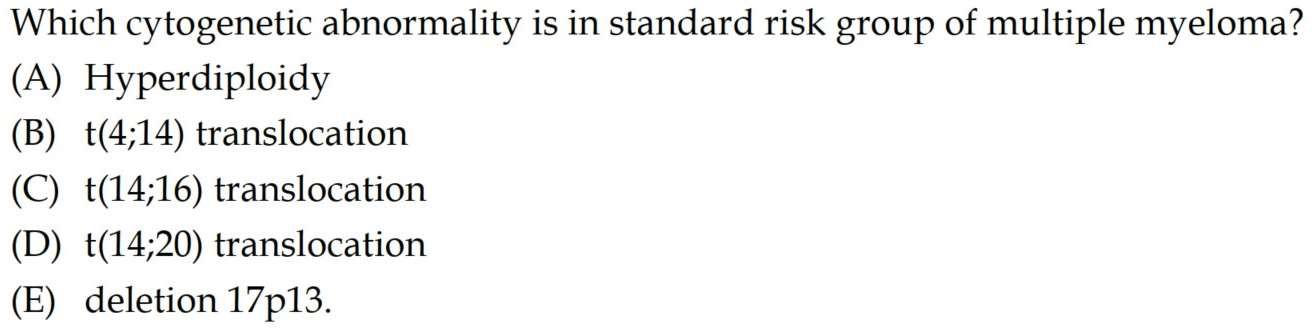
Q1. Which cytogenetic abnormality is in standard risk group of multiple myeloma?
- (A) Hyperdiploidy
- (B) t(4;14) translocation
- (C) t(14;16) translocation
- (D) t(14;20) translocation
- (E) deletion 17p13.
點此顯示正解
(A) Hyperdiploidy
詳解
Hyperdiploidy is classified as standard-risk in multiple myeloma because it is not associated with poorer prognosis and is specifically excluded from the high-risk cytogenetic abnormalities defined by the Revised International Staging System (R-ISS), IMWG consensus, and Mayo Clinic mSMART risk stratification systems.245[^13]
1. Why Hyperdiploidy is Standard-Risk
Hyperdiploidy is defined as trisomy of chromosomes 3, 5, 7, 9, 11, 15, 19, and/or 21, occurring in approximately 50-60% of multiple myeloma patients. This cytogenetic pattern is not associated with poorer prognosis and is therefore classified as standard-risk.[^13]
The R-ISS (Revised International Staging System), published by Palumbo et al. in the Journal of Clinical Oncology in 2015, specifically defines high-risk cytogenetics as the presence of t(4;14), t(14;16), or del(17p) detected by FISH.245 R-ISS Stage I requires the absence of these high-risk cytogenetic abnormalities, along with serum albumin ≥3.5 g/dL, beta-2-microglobulin <3.5 mg/L, and normal lactate dehydrogenase.25 Hyperdiploidy is not included in the high-risk category and therefore falls into the standard-risk group by default.
The Mayo Clinic mSMART risk stratification system similarly classifies approximately 75% of newly diagnosed patients as standard-risk, which includes patients with trisomies (hyperdiploidy), t(11;14), and t(6;14).5 The remaining 25% are classified as high-risk based on the presence of t(4;14), t(14;16), t(14;20), del(17p), or gain(1q).5
2. Why the Other Options are High-Risk
(B) t(4;14) translocation results in overexpression of the fibroblast growth factor receptor 3 (FGFR3) gene and NSD2/MMSET, occurs in approximately 7-8% of newly diagnosed patients, and is associated with significantly worse progression-free survival and overall survival (HR for OS 1.60, P=4.77 × 10⁻⁷).1[10][14] This translocation is included in all major high-risk classification systems including R-ISS, IMWG consensus, and mSMART.245
(C) t(14;16) translocation results in overexpression of the c-MAF oncogene, is identified in 3-5% of newly diagnosed patients, and confers poor prognosis with a hazard ratio for overall survival of 1.74 (P=0.0005).[10][13][^14] It is classified as high-risk in R-ISS and all major risk stratification systems.245
(D) t(14;20) translocation is a rare IgH translocation that is consistently classified as high-risk across all major systems (R-ISS, IMWG, mSMART), with a hazard ratio for overall survival of 1.90 (P=0.0089).15[^14] The recent 2025 IMWG/IMS consensus defines high-risk disease as including t(14;20) when present with 1q+ and/or del(1p32).3[^12]
(E) del(17p)/del(17p13) results from loss of the TP53 tumor suppressor gene on chromosome 17p, occurs in 5-20% of patients, and is associated with particularly poor outcomes (HR for OS 2.10, P=8.86 × 10⁻¹⁴).[10][13][^14] It is one of the three core high-risk abnormalities in R-ISS and is universally recognized as high-risk.245 The 2025 IMWG consensus recommends a cutoff of >20% clonal fraction for del(17p) to define high-risk disease.3[^12]
Patients with "double-hit" disease (co-occurrence of at least two adverse lesions) have especially poor prognosis with hazard ratios for overall survival of 2.67 (P=8.13 × 10⁻²⁷) for all patients and 3.19 (P=1.23 × 10⁻¹⁸) for intensively treated patients.[^14]
詳解 · 中文翻譯
超二倍體在多發性骨髓瘤中被分類為標準風險因為它與較差的預後無關,並特別排除在修訂的國際分期系統 (R-ISS)、IMWG 共識和 Mayo 診所 mSMART 風險分層系統定義的高風險細胞遺傳學異常之外245[^13]。
1. 為什麼超二倍體是標準風險
超二倍體定義為染色體 3、5、7、9、11、15、19 和/或 21 的三體性,發生於約 50-60% 的多發性骨髓瘤患者。此細胞遺傳學模式與較差的預後無關,因此被分類為標準風險[^13]。
R-ISS(修訂的國際分期系統),由 Palumbo 等人在 2015 年臨床腫瘤學雜誌發布,特別定義高風險細胞遺傳學為 FISH 檢測到的 t(4;14)、t(14;16) 或 del(17p) 的存在245。R-ISS 第 I 期要求缺乏這些高風險細胞遺傳學異常,連同血清白蛋白 ≥3.5 g/dL、β2 微球蛋白 <3.5 mg/L 和正常乳酸脫氫酶25。超二倍體未包括在高風險類別中,因此預設地歸入標準風險組。
Mayo 診所 mSMART 風險分層系統類似地將約 75% 的新診斷患者分類為標準風險,包括患有三體性(超二倍體)、t(11;14) 和 t(6;14) 的患者5。其餘 25% 根據 t(4;14)、t(14;16)、t(14;20)、del(17p) 或 gain(1q) 的存在被分類為高風險5。
2. 為什麼其他選項是高風險
(B) t(4;14) 易位導致纖維母細胞生長因子受體 3 (FGFR3) 基因和 NSD2/MMSET 的過度表達,發生於約 7-8% 的新診斷患者,與顯著更差的無進展生存和總生存相關(OS 的 HR 1.60,P=4.77 × 10⁻⁷)1[10][14]。此易位包括在所有主要高風險分類系統中,包括 R-ISS、IMWG 共識和 mSMART245。
(C) t(14;16) 易位導致 c-MAF 原癌基因的過度表達,在 3-5% 的新診斷患者中識別,並傳遞差預後,總生存的風險比為 1.74(P=0.0005)[10][13][^14]。它在 R-ISS 和所有主要風險分層系統中被分類為高風險245。
(D) t(14;20) 易位是罕見 IgH 易位,在所有主要系統(R-ISS、IMWG、mSMART)中一致地被分類為高風險,總生存的風險比為 1.90(P=0.0089)15[^14]。最近 2025 IMWG/IMS 共識定義高風險病為包括 t(14;20),當伴有 1q+ 和/或 del(1p32) 時3[^12]。
(E) del(17p)/del(17p13)由染色體 17p 上 TP53 腫瘤抑制基因喪失導致,發生於 5-20% 的患者,與特別差的預後相關(OS 的 HR 2.10,P=8.86 × 10⁻¹⁴)[10][13][^14]。它是 R-ISS 中三個核心高風險異常之一,並被通用地認為為高風險245。2025 IMWG 共識推薦 del(17p) 的 >20% 克隆分數的截止值以定義高風險病3[^12]。
具有「雙打擊」病的患者(至少兩個不利病變的共同發生)有特別差的預後,總生存的風險比為所有患者 2.67(P=8.13 × 10⁻²⁷)和強烈治療患者 3.19(P=1.23 × 10⁻¹⁸)[^14]。
參考文獻 (AMA)
-
Rajkumar SV. Multiple Myeloma: 2022 Update on Diagnosis, Risk Stratification, and Management. American Journal of Hematology. 2022;97(8):1086-1107. doi:10.1002/ajh.26590. PMID:35560063. ↩↩↩↩
-
Mikhael J, Ismaila N, Cheung MC, et al. Treatment of Multiple Myeloma: ASCO and CCO Joint Clinical Practice Guideline. Journal of Clinical Oncology : Official Journal of the American Society of Clinical Oncology. 2019;37(14):1228-1263. doi:10.1200/JCO.18.02096. PMID:30932732. ↩↩↩↩↩↩↩↩↩↩↩↩
-
Rajkumar SV. Multiple Myeloma: 2020 Update on Diagnosis, Risk-Stratification and Management. American Journal of Hematology. 2020;95(5):548-567. doi:10.1002/ajh.25791. PMID:32212178. ↩↩↩↩
-
Cowan AJ, Green DJ, Kwok M, et al. Diagnosis and Management of Multiple Myeloma: A Review. Jama. 2022;327(5):464-477. doi:10.1001/jama.2022.0003. PMID:35103762. ↩↩↩↩↩↩↩↩↩↩
-
Shah V, Sherborne AL, Walker BA, et al. Prediction of Outcome in Newly Diagnosed Myeloma: A Meta-Analysis of the Molecular Profiles of 1905 Trial Patients. Leukemia. 2018;32(1):102-110. doi:10.1038/leu.2017.179. PMID:28584253. ↩↩↩↩↩↩↩↩↩↩↩↩↩↩↩↩↩↩
-
Avet-Loiseau H, Davies FE, Samur MK, et al. International Myeloma Society/International Myeloma Working Group Consensus Recommendations on the Definition of High-Risk Multiple Myeloma. Journal of Clinical Oncology : Official Journal of the American Society of Clinical Oncology. 2025;:JCO2401893. doi:10.1200/JCO-24-01893. PMID:40489728. ↩
Figures