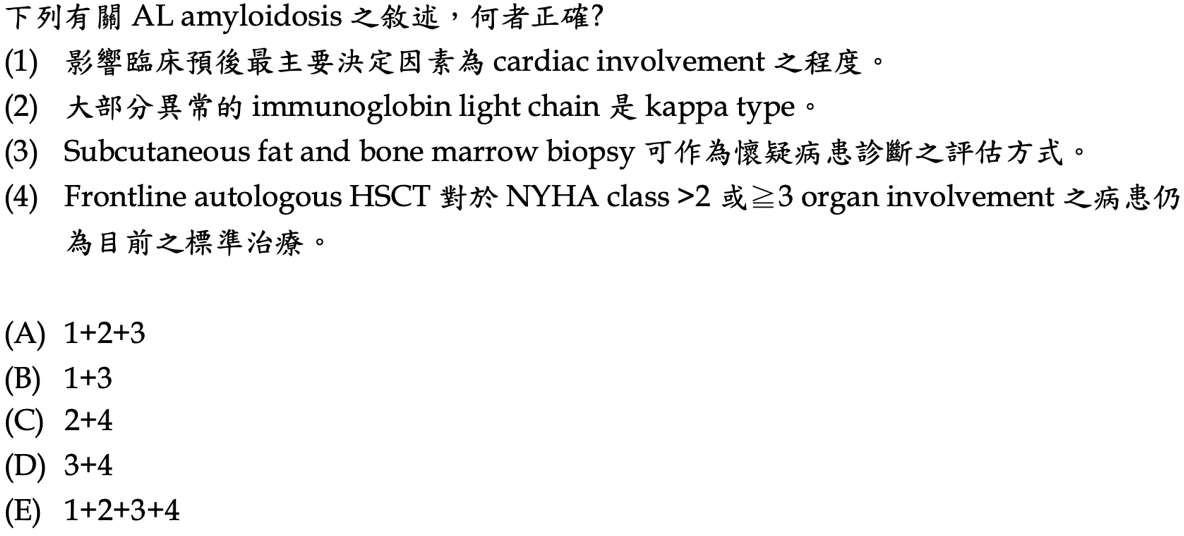
Q1. 下列有關 AL amyloidosis 之敘述,何者正確?
(1) 影響臨床預後最主要決定因素為 cardiac involvement 之程度。 (2) 大部分異常的 immunoglobin light chain 是 kappa type。 (3) Subcutaneous fat and bone marrow biopsy 可作為懷疑病患診斷之評估方式。 (4) Frontline autologous HSCT 對於 NYHA class >2 或 ≧3 organ involvement 之病患仍為目前之標準治療。
- (A) 1+2+3
- (B) 1+3
- (C) 2+4
- (D) 3+4
- (E) 1+2+3+4
點此顯示正解
(B) 1+3
詳解
Answer
Answer (B) = 1+3 is correct because statements 1 and 3 are TRUE, while statements 2 and 4 are FALSE.
1. Why (B) Matches the Stem Framing
The question asks "何者正確?" (which is correct?), meaning we need to identify the TRUE statements.
Statement 1 is TRUE: Cardiac involvement is indeed the most important prognostic determinant in AL amyloidosis. Survival is highly dependent on the severity of cardiac dysfunction at diagnosis—patients with advanced cardiac involvement have median survival of 3-6 months, while those without cardiac involvement can survive many years1. All major staging systems (Mayo 2004, Mayo 2012, European modification) are based primarily on cardiac biomarkers (NT-proBNP and troponins), confirming that cardiac involvement is the primary prognostic factor1345.
Statement 3 is TRUE: Subcutaneous fat aspiration and bone marrow biopsy are established diagnostic approaches for suspected AL amyloidosis. These are standard tissue sampling methods used to obtain specimens for Congo red staining and subsequent amyloid typing4.
Therefore, 1+3 (option B) correctly identifies the two true statements.
2. Why the Other Statements Are FALSE
Statement 2 is FALSE: The majority of abnormal immunoglobulin light chains in AL amyloidosis are lambda type, not kappa. Lambda light chains predominate in AL amyloidosis, which distinguishes it from multiple myeloma where kappa is more common. This is a well-established characteristic of AL amyloidosis.
Statement 4 is FALSE: Frontline autologous HSCT is NOT standard treatment for patients with NYHA class >2 or ≥3 organ involvement. In fact, these are generally contraindications to transplant: - Only 10-20% of newly diagnosed AL amyloidosis patients are eligible for SCT due to poor performance status, advanced organ dysfunction, and multiorgan disease[^8] - Only 20-25% of patients are considered eligible for stem cell transplant, with exclusion criteria including advanced heart failure, significant kidney impairment, and functional impairment[10][11] - An ejection fraction <40% is generally considered a contraindication to SCT[^7] - Patients with advanced cardiac involvement (NYHA class >2) and those with ≥3 organ involvement typically have too high a risk for transplant-related mortality and are treated with chemotherapy regimens instead (such as daratumumab-CyBorD)[8][9]
3. Why Other Options Are Incorrect
- (A) 1+2+3: Incorrect because statement 2 is false (lambda predominates, not kappa)
- (C) 2+4: Incorrect because both statements 2 and 4 are false
- (D) 3+4: Incorrect because statement 4 is false
- (E) 1+2+3+4: Incorrect because statements 2 and 4 are both false
詳解 · 中文翻譯
答案
答案 (B) = 1+3 是正確的因為敘述 1 和 3 是真實的,而敘述 2 和 4 是假的。
1. 為什麼 (B) 符合題幹框架
問題要求「何者正確?」(哪個是正確的?),意思是我們需要識別真實的敘述。
敘述 1 是真實的:心臟受累確實是 AL 澱粉樣變中最重要的預後決定因素。生存高度依賴於診斷時心臟功能障礙的嚴重程度—具有高級心臟受累的患者有 3-6 個月的中位生存,而無心臟受累的患者可生存多年1。所有主要分期系統(Mayo 2004、Mayo 2012、歐洲修改)主要基於心臟生物標誌物(NT-proBNP 和肌鈣蛋白),確認心臟受累是主要預後因素1345。
敘述 3 是真實的:皮下脂肪吸取和骨髓生檢是懷疑 AL 澱粉樣變的既定診斷方法。這些是用於獲得標本用於剛果紅染色和後續澱粉樣變分型的標準組織取樣方法4。
因此,1+3(選項 B)正確地識別了兩個真實的敘述。
2. 為什麼其他敘述是假的
敘述 2 是假的:AL 澱粉樣變中異常免疫球蛋白輕鏈的多數是 lambda 型,而不是 kappa。Lambda 輕鏈在 AL 澱粉樣變中佔優勢,這區分它與多發性骨髓瘤,其中 kappa 更常見。這是 AL 澱粉樣變的眾所周知的特徵。
敘述 4 是假的:一線自體 HSCT 不是NYHA II 級 >2 或 ≥3 器官受累患者的標準治療。實際上,這些通常是移植的禁忌症: - 只有 10-20% 的新診斷 AL 澱粉樣變患者因差的性能狀態、高級器官功能障礙和多器官病符合 SCT 合格[^8] - 只有 20-25% 的患者被認為符合幹細胞移植合格,排除標準包括高級心衰、顯著腎受損和功能障礙[10][11] - 射血分數 <40% 通常被認為是 SCT 的禁忌症[^7] - 具有高級心臟受累(NYHA II 級 >2)和那些具有 ≥3 器官受累的患者通常有移植相關死亡率過高的風險,使用化療方案代替治療(例如 daratumumab-CyBorD)[8][9]。
3. 為什麼其他選項是不正確的
- (A) 1+2+3:不正確因為敘述 2 是假的(lambda 佔優勢,而不是 kappa)
- (C) 2+4:不正確因為敘述 2 和 4 都是假的
- (D) 3+4:不正確因為敘述 4 是假的
- (E) 1+2+3+4:不正確因為敘述 2 和 4 都是假的
參考文獻 (AMA)
-
Sanchorawala V. Systemic Light Chain Amyloidosis. The New England Journal of Medicine. 2024;390(24):2295-2307. doi:10.1056/NEJMra2304088. PMID:38924733. ↩↩↩↩
-
Pregenzer-Wenzler A, Abraham J, Barrell K, Kovacsovics T, Nativi-Nicolau J. Utility of Biomarkers in Cardiac Amyloidosis. JACC. Heart Failure. 2020;8(9):701-711. doi:10.1016/j.jchf.2020.03.007. PMID:32653441. ↩
-
Gertz MA, Dispenzieri A. Systemic Amyloidosis Recognition, Prognosis, and Therapy: A Systematic Review. Jama. 2020;324(1):79-89. doi:10.1001/jama.2020.5493. PMID:32633805. ↩↩
-
Kittleson MM, Ruberg FL, Ambardekar AV, et al. 2023 ACC Expert Consensus Decision Pathway on Comprehensive Multidisciplinary Care for the Patient With Cardiac Amyloidosis: A Report of the American College of Cardiology Solution Set Oversight Committee. Journal of the American College of Cardiology. 2023;81(11):1076-1126. doi:10.1016/j.jacc.2022.11.022. PMID:36697326. ↩↩↩↩
-
Abdallah M, Sanchorawala V. Update on the Contemporary Treatment of Light Chain Amyloidosis Including Stem Cell Transplantation. The American Journal of Medicine. 2022;135 Suppl 1:S30-S37. doi:10.1016/j.amjmed.2022.01.011. PMID:35081382. ↩↩
Figures