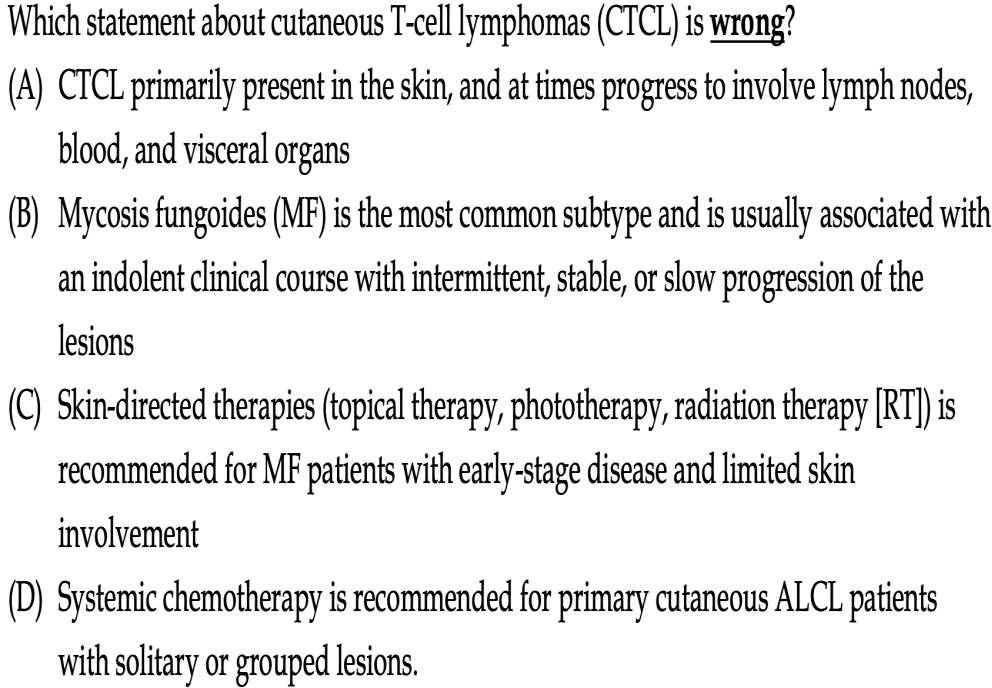
Q1. Which statement about cutaneous T-cell lymphomas (CTCL) is wrong?
- (A) CTCL primarily present in the skin, and at times progress to involve lymph nodes, blood, and visceral organs
- (B) Mycosis fungoides (MF) is the most common subtype and is usually associated with an indolent clinical course with intermittent, stable, or slow progression of the lesions
- (C) Skin-directed therapies (topical therapy, phototherapy, radiation therapy [RT]) is recommended for MF patients with early-stage disease and limited skin involvement
- (D) Systemic chemotherapy is recommended for primary cutaneous ALCL patients with solitary or grouped lesions
點此顯示正解
(D) Systemic chemotherapy is recommended for primary cutaneous ALCL patients with solitary or grouped lesions
詳解
Analysis of Board Question
1) Why (D) is the WRONG statement (matching the stem framing):
Statement (D) is incorrect because systemic chemotherapy is NOT recommended for primary cutaneous ALCL (PC-ALCL) patients with solitary or grouped lesions. Instead, the recommended first-line treatments are surgical excision or radiation therapy12.
The EORTC/ISCL/USCLC consensus guidelines explicitly state that for solitary or grouped PC-ALCL lesions, "SE [surgical excision] or RT [radiation therapy] is recommended as initial or first-line therapy," achieving complete response rates of at least 95%1. The NCCN guidelines similarly recommend "ISRT [involved-site radiation therapy] or surgical excision ± ISRT" for solitary or grouped PC-ALCL lesions2.
Importantly, these same guidelines specifically recommend against multiagent chemotherapy for localized disease. The consensus states: "multiagent chemotherapy and, in particular, CHOP can no longer be recommended as first-line therapy for multifocal or relapsing PCALCL limited to the skin"1. Multiagent chemotherapy is only indicated for extracutaneous spread1. Even for multifocal PC-ALCL, preferred options include brentuximab vedotin, methotrexate, or systemic retinoids—not traditional systemic chemotherapy2.
2) Why the other options are TRUE (and therefore not the answer):
(A) TRUE: CTCL does primarily present in the skin and can progress to involve lymph nodes, blood, and visceral organs. This accurately describes the natural history of CTCL, particularly mycosis fungoides, which begins as skin-limited disease and may advance to extracutaneous involvement in later stages6[^8]. The staging system for MF/SS uses the TNMB classification reflecting skin (T), nodal (N), visceral (M), and blood (B) involvement6.
(B) TRUE: Mycosis fungoides is indeed the most common CTCL subtype, accounting for approximately 60% of all CTCL diagnoses[^8], and is characterized by an indolent clinical course. MF typically demonstrates "intermittent, stable, or slow progression" with early-stage patients having life expectancy similar to age-matched controls6[7][10]. The disease progresses through distinct patch, plaque, and tumor stages over years to decades[^8].
(C) TRUE: Skin-directed therapies are the recommended first-line approach for early-stage MF with limited skin involvement. Guidelines consistently recommend skin-directed therapies including topical corticosteroids, phototherapy (PUVA, UVB), topical chemotherapy, and localized radiation therapy for early-stage disease (stages IA-IIA)6[7][9][^10]. This stage-adapted approach prioritizes skin-directed treatments for patients with disease confined to the skin, reserving systemic therapies for refractory early-stage or advanced-stage disease[7][10].
詳解 · 中文翻譯
棋盤問題分析
1) 為何 (D) 是錯誤陳述(符合題幹框架):
陳述 (D) 不正確,因為 系統化學治療不推薦 用於原發性皮膚 ALCL(PC-ALCL)患者伴隨單發或分組病變。相反,推薦的一線治療是 手術切除或放射治療12。
EORTC/ISCL/USCLC 共識指南明確指出,對於單發或分組 PC-ALCL 病變,「SE [手術切除] 或 RT [放射治療] 推薦為初始或一線治療」,達到至少 95% 的完全反應率1。NCCN 指南類似地推薦「ISRT [浸潤部位放射治療] 或手術切除 ± ISRT」用於單發或分組 PC-ALCL 病變2。
重要地,這些相同指南明確推薦 反對 多藥化學治療用於局限性疾病。共識指出:「多藥化學治療,特別是 CHOP 不再可推薦作為限於皮膚的多灶性或復發 PCALCL 的一線治療」1。多藥化學治療僅在皮膚外侵佔時指示1。即使對於多灶性 PC-ALCL,首選選項包括 brentuximab vedotin、甲氨蝶呤或系統性視黃醇類——而非傳統系統化學治療2。
2) 其他選項為何真實(因此不是答案):
(A) 真實: CTCL 確實主要呈現在皮膚並可進展涉及淋巴結、血液和內臟器官。這準確描述了 CTCL 的自然歷史,特別是菌樣肉芽腫,始於皮膚限局性疾病,可在晚期進展至皮膚外浸潤6[^8]。MF/SS 的分期系統使用 TNMB 分類反映皮膚(T)、結點(N)、內臟(M)和血液(B)浸潤6。
(B) 真實: 菌樣肉芽腫確實是最常見的 CTCL 亞型,佔約 60% 的所有 CTCL 診斷[^8],並以惰性臨床病程為特徵。MF 通常表現「間歇性、穩定或緩慢進展」,早期患者的生存期與年齡匹配對照相似6[7][10]。疾病通過不同斑疹、斑塊和腫瘤階段進展,經歷多年至數十年[^8]。
(C) 真實: 皮膚導向治療是早期 MF 伴隨有限皮膚浸潤的推薦一線方法。指南一致推薦皮膚導向治療,包括局部皮質類固醇、光療(PUVA、UVB)、局部化療和局限性放射治療用於早期疾病(第 IA-IIA 期)6[7][9][10]。此分期調整方法優先皮膚導向治療用於疾病限於皮膚的患者,保留系統性治療用於難治早期或晚期疾病[7][^10]。
參考文獻 (AMA)
-
Kempf W, Pfaltz K, Vermeer MH, et al. EORTC, ISCL, and USCLC Consensus Recommendations for the Treatment of Primary Cutaneous CD30-positive Lymphoproliferative Disorders: Lymphomatoid Papulosis and Primary Cutaneous Anaplastic Large-Cell Lymphoma. Blood. 2011;118(15):4024-35. doi:10.1182/blood-2011-05-351346. PMID:21841159. ↩↩↩↩↩↩↩↩
-
National Comprehensive Cancer Network. Cutaneous Lymphomas. https://www.nccn.org/professionals/physician_gls/pdf/cutaneous_lymphomas.pdf#page=51. ↩↩↩↩↩↩
-
Miyashiro D, Sanches JA. Mycosis Fungoides and Sézary Syndrome: Clinical Presentation, Diagnosis, Staging, and Therapeutic Management. Frontiers in Oncology. 2023;13:1141108. doi:10.3389/fonc.2023.1141108. PMID:37124514. ↩
-
Sheern C, Levell NJ, Craig PJ, et al. Mycosis Fungoides: A Review. Clinical and Experimental Dermatology. 2025;:llaf341. doi:10.1093/ced/llaf341. PMID:40721285. ↩
-
Whittaker S, Hoppe R, Prince HM. How I Treat Mycosis Fungoides and Sézary Syndrome. Blood. 2016;127(25):3142-53. doi:10.1182/blood-2015-12-611830. PMID:27151889. ↩
-
Valipour A, Jäger M, Wu P, et al. Interventions for Mycosis Fungoides. The Cochrane Database of Systematic Reviews. 2020;7:CD008946. doi:10.1002/14651858.CD008946.pub3. PMID:32632956. ↩↩↩↩↩↩↩↩
Slide annotations
Surgery/localized RT
Figures