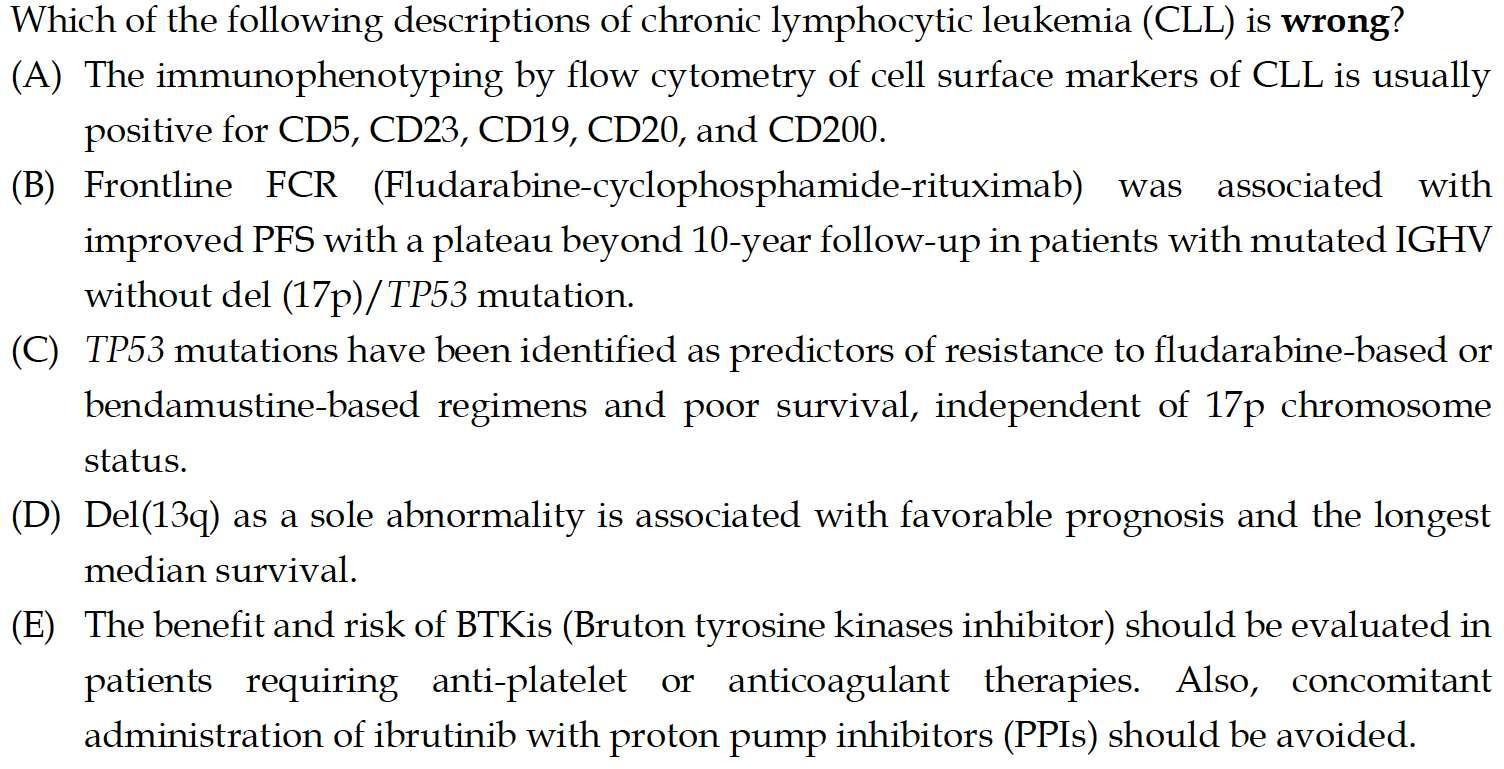
Q1. Which of the following descriptions of chronic lymphocytic leukemia (CLL) is wrong?
- (A) The immunophenotyping by flow cytometry of cell surface markers of CLL is usually positive for CD5, CD23, CD19, CD20, and CD200.
- (B) Frontline FCR (Fludarabine-cyclophosphamide-rituximab) was associated with improved PFS with a plateau beyond 10-year follow-up in patients with mutated IGHV without del (17p)/TP53 mutation.
- (C) TP53 mutations have been identified as predictors of resistance to fludarabine-based or bendamustine-based regimens and poor survival, independent of 17p chromosome status.
- (D) Del(13q) as a sole abnormality is associated with favorable prognosis and the longest median survival.
- (E) The benefit and risk of BTKis (Bruton tyrosine kinases inhibitor) should be evaluated in patients requiring anti-platelet or anticoagulant therapies. Also, concomitant administration of ibrutinib with proton pump inhibitors (PPIs) should be avoided.
點此顯示正解
(E) The benefit and risk of BTKis (Bruton tyrosine kinases inhibitor) should be evaluated in patients requiring anti-platelet or anticoagulant therapies. Also, concomitant administration of ibrutinib with proton pump inhibitors (PPIs) should be avoided.
詳解
Why (E) is the WRONG statement
The second part of option (E) states that "concomitant administration of ibrutinib with proton pump inhibitors (PPIs) should be avoided." This is incorrect. While early theoretical concerns existed about PPIs reducing ibrutinib absorption due to pH effects, clinical evidence demonstrates that PPIs do not require dose adjustment or avoidance with ibrutinib12. A pharmacokinetic study showed that omeprazole decreased ibrutinib Cmax by 62.5% but had no clinically significant effect on AUC (area under the curve), with the overall exposure remaining adequate1. Importantly, mechanistic modeling demonstrated no impact on BTK target engagement, and the study concluded that "no dose adjustments are recommended during ibrutinib's co-administration with omeprazole or other pH-altering agents"1. Real-world Australian data confirmed that over half of patients with relapsed/refractory CLL use concomitant PPIs with ibrutinib, with no difference in treatment duration or persistence2.
The first part of option (E) regarding careful evaluation of BTK inhibitors in patients requiring antiplatelet or anticoagulant therapy is correct and represents an important clinical consideration6[7][8][^9].
Why the other options are CORRECT statements
(A) is correct: The immunophenotype described is the classic CLL profile. CLL cells characteristically express CD5, CD23, CD19, CD20 (dim), and CD200. This combination, particularly the co-expression of CD5 (a T-cell marker) with B-cell markers (CD19, CD20) and CD23, is diagnostic for CLL and distinguishes it from other B-cell lymphoproliferative disorders[^8].
(B) is correct: The CLL8 trial demonstrated that FCR in patients with mutated IGHV without del(17p)/TP53 mutation achieved a plateau in PFS beyond 10 years, with approximately 60% of these favorable-risk patients remaining progression-free at 10+ years. This represents one of the few scenarios in CLL where chemoimmunotherapy can produce durable remissions approaching cure in a subset of patients[^8].
(C) is correct: TP53 mutations predict resistance to fludarabine-based and bendamustine-based regimens independent of 17p deletion status. Patients can have TP53 mutations without del(17p), and these mutations confer similarly poor outcomes with chemoimmunotherapy. This is why both del(17p) and TP53 mutation status should be assessed, and either abnormality mandates avoiding chemoimmunotherapy in favor of targeted agents like BTK inhibitors or venetoclax[8][9].
(D) is correct: Del(13q) as a sole abnormality is the most favorable cytogenetic abnormality in CLL, associated with the longest median survival (>10 years in many series). This contrasts with del(17p) (worst prognosis), del(11q) (intermediate-poor), trisomy 12 (intermediate), and normal karyotype (intermediate-favorable)[^8].
詳解 · 中文翻譯
(E) 為什麼是錯誤的敘述
選項 (E) 的第二部分指出「應避免 ibrutinib 與質子泵抑制劑 (PPI) 的併用」。這是不正確的。雖然早期曾有理論上的顧慮,認為 PPI 可能因 pH 效應而降低 ibrutinib 吸收,但臨床證據顯示 PPI 不需要調整劑量或避免與 ibrutinib 併用12。藥物動力學研究顯示,omeprazole 將 ibrutinib 的最大血藥濃度 (Cmax) 降低 62.5%,但對曲線下面積 (AUC) 沒有臨床顯著影響,整體暴露仍然充分1。重要的是,機制模型顯示對 BTK 靶點結合沒有影響,研究結論為「ibrutinib 與 omeprazole 或其他改變 pH 的物質併用時不建議調整劑量」1。澳洲真實世界數據證實,超過一半的復發/難治 CLL 患者在使用 ibrutinib 時併用 PPI,治療期間和持續性沒有差異2。
選項 (E) 的第一部分關於在需要使用抗血小板或抗凝血藥物的患者中謹慎評估 BTK 抑制劑是正確的,代表重要的臨床考量6[7][8][^9]。
為什麼其他選項是正確的敘述
(A) 正確:所述免疫表型是 CLL 的典型表現。CLL 細胞特徵性表達 CD5、CD23、CD19、CD20(弱陽性)和 CD200。這種組合,特別是 CD5(T 細胞標誌)與 B 細胞標誌(CD19、CD20)和 CD23 的共表達,是 CLL 的診斷特徵,並將其與其他 B 細胞淋巴增生性疾病區分開來[^8]。
(B) 正確:CLL8 試驗證實,在無 del(17p)/TP53 突變的 IGHV 突變患者中,FCR 達成超過 10 年的 PFS 平台期,約 60% 的這些高危風險患者在 10 年以上時仍無進展。這代表 CLL 中少數情況之一,化學免疫療法可在患者的一個亞群中產生接近完全緩解的持久緩解[^8]。
(C) 正確:TP53 突變預測對氟達拉濱和苯達莫司汀為基礎的方案的耐藥性,與 del(17p) 缺失狀態無關。患者可能具有 TP53 突變但無 del(17p),這些突變對化學免疫療法的預後同樣差。這就是為什麼應評估 del(17p) 和 TP53 突變狀態,任何一種異常都應避免使用化學免疫療法,改用 BTK 抑制劑或 venetoclax 等靶向藥物[8][9]。
(D) 正確:Del(13q) 單獨出現是 CLL 中最有利的細胞遺傳學異常,與最長的中位生存期相關(許多系列中 >10 年)。這與 del(17p)(最差預後)、del(11q)(中等-較差)、三體 12(中等)和正常核型(中等-有利)形成對比[^8]。
參考文獻 (AMA)
-
de Jong J, Haddish-Berhane N, Hellemans P, et al. The pH-altering Agent Omeprazole Affects Rate but Not the Extent of Ibrutinib Exposure. Cancer Chemotherapy and Pharmacology. 2018;82(2):299-308. doi:10.1007/s00280-018-3613-9. PMID:29882017. ↩↩↩↩↩↩
-
Salvaris R, Mulligan S, Puig A, McGeachie M, Opat S. Australian Data on the Utilisation and Duration on Treatment of Ibrutinib With a Proton Pump Inhibitor in Patients With Relapsed or Refractory Chronic Lymphocytic Leukaemia. Internal Medicine Journal. 2023;53(11):2115-2118. doi:10.1111/imj.16267. PMID:37950615. ↩↩↩↩
-
Ganatra S, Barac A, Armenian S, et al. Diagnosis and Management of Cardiovascular Adverse Effects of Targeted Oncology Therapies: Bruton's Tyrosine Kinase, Immune Checkpoint, and Vascular Endothelial Growth Factor Inhibitors: 2025 ACC Concise Clinical Guidance: A Report of the American College of Cardiology Solution Set Oversight Committee. Journal of the American College of Cardiology. 2025;:S0735-1097(25)09916-4. doi:10.1016/j.jacc.2025.10.018. PMID:41369617. ↩
-
Lenihan D, Bloom M, Copeland-Halperin R, et al. Considerations for the Practical Management of Cardiovascular Risk With Bruton's Tyrosine Kinase Inhibitors for Patients With CLL. The Oncologist. 2025;:oyaf237. doi:10.1093/oncolo/oyaf237. PMID:40737507. ↩
-
Shadman M. Diagnosis and Treatment of Chronic Lymphocytic Leukemia: A Review. Jama. 2023;329(11):918-932. doi:10.1001/jama.2023.1946. PMID:36943212. ↩
-
Burger JA. Treatment of Chronic Lymphocytic Leukemia. The New England Journal of Medicine. 2020;383(5):460-473. doi:10.1056/NEJMra1908213. PMID:32726532. ↩↩
Slide correction
should be avoided.
Slide annotations
The pH-altering agent omeprazole affects rate but not the extent of ibrutinib exposure. Cancer Chemother Pharmacol. 2018 Aug;82(2):299-308.
Figures